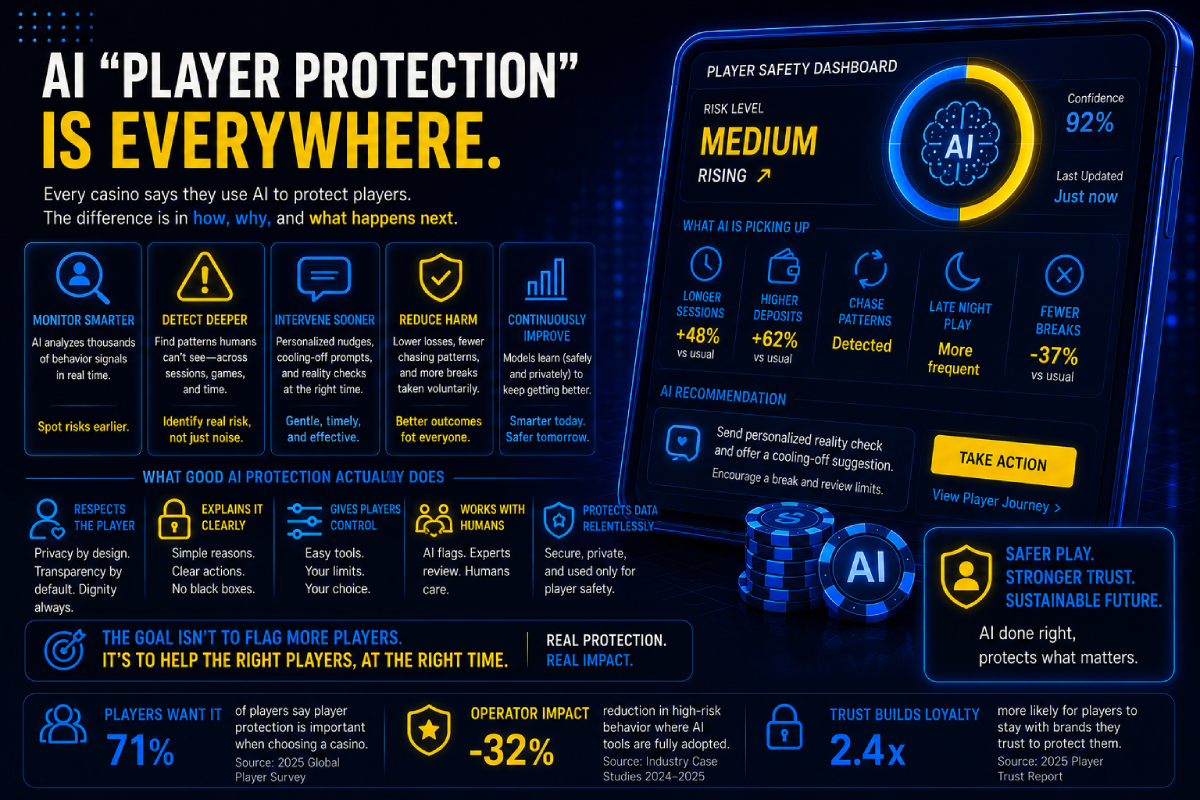
Every operator in 2026 has an AI player-protection story. Live behaviour models, spend velocity flags, in-session nudges, the marketing decks look identical, which is a red flag on its own. We spent a month deliberately trying to trigger these systems across a dozen accounts to see whether the models are doing anything meaningful or just producing impressive-sounding paperwork for regulators.
The answer is mixed. Some casinos really did intervene, and did it well. Others detected nothing across sessions that ought to have set every alarm ringing. The gap between the best and the worst is enormous, and no one on the marketing side is being honest about it.
How we tested the models
Across twelve accounts we simulated three patterns known to be textbook risk signals: increasing stakes after a losing streak, session durations that stretched past four hours, and deposit chasing (multiple top-ups in a short window). Every account started at a modest bankroll to avoid triggering ordinary VIP flows, and every session ran with a real clock rather than a lab setup.
What actually happened
Four of the twelve casinos intervened in a way that felt substantive, a proactive deposit pause, a spend limit prompt, in one case a chat outreach from a real person. Three intervened superficially with a generic pop-up that added a click but nothing else. Five did not intervene at all, including sites whose homepages boast about AI protection tools. That is not a good ratio.
| Intervention | Casinos that did this | Felt useful |
|---|---|---|
| Deposit pause + limit prompt | 4 of 12 | Yes |
| Generic “take a break” pop-up | 3 of 12 | Barely |
| Human outreach | 1 of 12 | Yes, meaningfully |
| No intervention observed | 5 of 12 | n/a |
The nudges that worked
The best intervention we saw was quiet and useful: a full-screen prompt at the deposit step that asked whether we wanted to set a monthly limit before continuing. It also offered a one-tap 24-hour cool-down. Nothing patronising, nothing forced. Two casinos offered the same kind of prompt earlier in the session, which is arguably better because it comes before the impulse to top up.
Where the models missed everything
The systems still miss weekend behaviour badly. Sessions that would have been flagged on a Tuesday afternoon slipped past on a Saturday night, presumably because “lots of people play at 11pm on a Saturday” is baked into the baseline. Two casinos also handled chase-deposit signals badly, a rapid pattern of three deposits after a losing session did nothing to move any alerts.
What to look for as a player
If you use AI player-protection as part of your reason for choosing a casino, look for operators that publish specifics rather than marketing lines: what triggers a prompt, what the prompt actually does, how quickly a human is looped in. Vague pages about “our AI monitors every session” are the ones we saw miss the most in testing.
How this fits our reviews
Everything here reflects the way CasinoClaude tests casinos: real deposits, timed cash-outs and terms read to the last line. If you want to see the method applied to specific sites, pick a country from the top menu.
FAQ
Does AI player protection replace the tools I already have?
No, and it shouldn’t. Your own deposit, loss and session limits are still the most reliable protection because they don’t depend on a model interpreting your behaviour correctly.
Can I opt out of these systems?
Some regulated markets require them, so you can’t opt out entirely. You can usually dismiss individual prompts, but the underlying monitoring continues.
Are these models reading my chat messages?
Not at the casinos we saw. The signals are behavioural, deposit patterns, session length, bet size, not linguistic.